
Josh Aharonoff – Financial Modeling Fundamentals Course
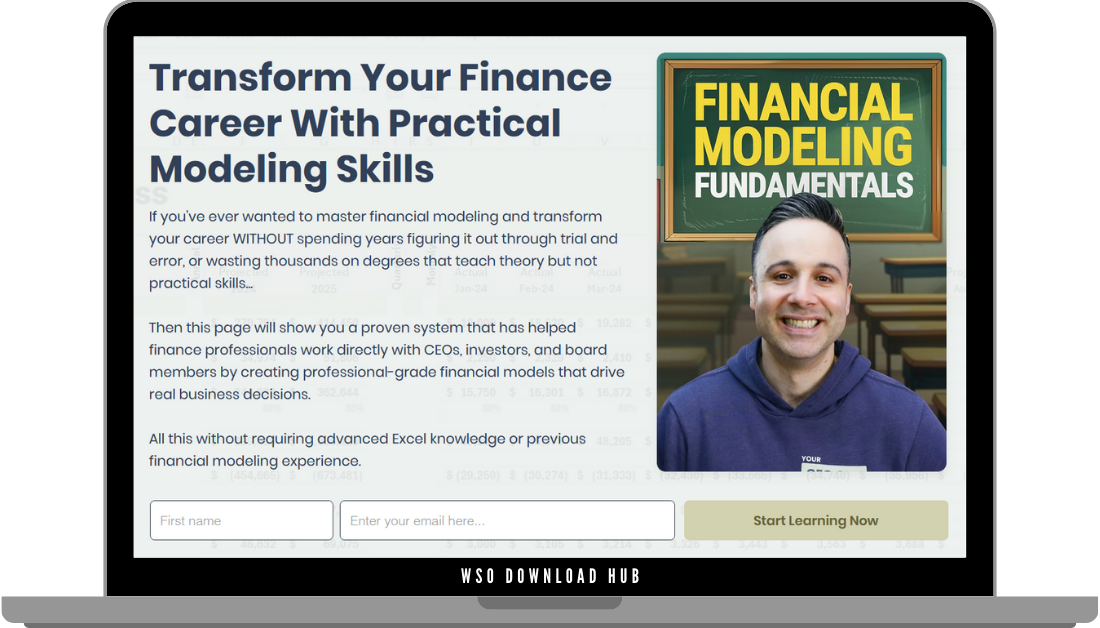
A strong model can change a finance career. It can also change how leaders make decisions. The Financial Modeling Fundamentals Course teaches practical skills that help you build models executives can use.
Many finance roles demand modeling. However, most people learn through messy trial and error. Others spend thousands on theory-heavy programs. This training takes a different path. It focuses on real-world models that support CEOs, investors, and board members.
You do not need advanced Excel skills to start. You also do not need prior modeling experience. Instead, you follow a clear system and build step by step. As a result, you gain confidence faster and avoid common mistakes.
What You Can Achieve With the Financial Modeling Fundamentals Course
The Financial Modeling Fundamentals Course aims to make you useful in high-stakes conversations. It trains you to translate business activity into numbers. Then it helps you connect those numbers into a full story.
By the end, you can create professional-grade models that:
- connect the income statement, balance sheet, and cash flow statement
- include drivers, checks, and clean structure
- support projections and monthly updates with actual results
- present clear summaries that leaders understand quickly
Moreover, you learn to organize your work like a professional. That skill matters when people rely on your output.
Why Financial Modeling Matters for Your Career
Financial modeling is more than spreadsheets. It is decision support. When leaders ask “what happens if,” your model should answer clearly. Therefore, the ability to model well increases your value.
A good model also improves communication. It forces clarity on assumptions. It shows tradeoffs and constraints. As a result, you can speak to strategy, not only reporting.
The Financial Modeling Fundamentals Course focuses on that practical outcome. It teaches you to build models that drive action.
Course Structure and Learning Flow
This program moves from fundamentals to full models. It starts with core statements. Then it builds templates. Next, it connects everything into a three-statement model. Finally, it strengthens the model with best practices and projections.
You learn through short lessons and hands-on builds. Therefore, you practice as you go.
Module 1: Introduction to Financial Modeling
You begin with the course roadmap and the goal. You learn what a financial model is and why it matters. Then you set expectations for the full learning journey.
This module helps you align on purpose. It also frames modeling as a career lever. As a result, you start with motivation and clarity.
Module 2: Refresher on Financial Statements
Every strong model starts with strong statement knowledge. This module reviews the P&L, balance sheet, and cash flow statement. Then it explains how they connect in the real world.
You also cover cash versus accrual accounting. You review debits and credits. Moreover, you learn how changes flow across statements. Therefore, you build the mental map that modeling requires.
Module 3: Build Your First Financial Statements
Next, you create templates from scratch. You build summary and detailed versions of the P&L and balance sheet. You learn structure, formatting, and calculation methods that match best practices.
This module helps you avoid messy spreadsheets. It also teaches consistency and readability. As a result, your work looks professional and stays easy to audit.
Module 4: Build a Statement of Cash Flows
Many learners fear cash flow statements. This module makes them manageable. You build the cash flow statement using the indirect method. Then you categorize cash movements correctly.
You also learn how to ensure everything balances. Moreover, you explore the logic behind cash flow changes. Therefore, you stop treating cash flow as a mystery.
Module 5: Build a Basic Three-Statement Model
Now you connect all three statements into one model. You link changes in one statement to the others. You also verify that your model balances using validation techniques.
This step changes everything. Your spreadsheet becomes a system. As a result, you can test scenarios and see impacts immediately.
Financial Modeling Fundamentals That Separate Pros From Amateurs
A working model is not enough. A professional model needs structure and controls. The Financial Modeling Fundamentals Course includes a module dedicated to core modeling principles.
Module 6: Financial Modeling Fundamentals
You learn how professionals organize models. You work with drivers tabs. You set up template tabs and summary outputs. You also learn version control concepts.
In addition, you add error checks and auditing habits. You apply color coding to improve clarity. Therefore, you reduce mistakes and speed up review.
Module 7: Optimize Your Model
After you build the model, you upgrade it. You implement a clear color system. You create stronger error checks. You also add user-friendly instructions.
Then you connect summary financials and dashboards. As a result, executives can read the model without digging.
This module focuses on presentation and trust. Clear models earn trust faster. Therefore, your work becomes more influential.
Working With Real Numbers and Forecasts
Models should evolve with the business. They should also incorporate real results. The Financial Modeling Fundamentals Course covers that workflow.
Module 8: Working With Historical Data
You learn how to include actual historical financial data. Then you learn the monthly process for updating the model with actuals. You also maintain integrity with verification and version control.
This skill matters in real jobs. Teams update models often. Therefore, you need a repeatable process that stays clean.
Module 9: Financial Projections
Next, you learn projection methods for revenue, expenses, and balance sheet accounts. You forecast in a way that tells a coherent story. You also build projections that hold up under scrutiny.
This module helps you move beyond guesswork. It teaches structure around assumptions. As a result, stakeholders can challenge inputs without breaking the model.
Build a Full Three-Statement Model From Scratch
The course ends with a full build. You apply everything in a complete model.
Module 10: Full Model Setup
You set up structure, drivers, and statement links. You create drivers for the P&L and balance sheet. Then you link statements to drivers. You also build the cash flow statement and summary sections.
This module reinforces best practices. Therefore, your final model looks and behaves like professional work.
Module 11: Projections and Actualizing
You complete the model with projections across key sections. You project revenue, COGS, opex, and other items. You also project assets, liabilities, and owners’ equity.
Then you roll forward monthly with new actuals. You learn variance analysis and insights. In addition, you build a budget versus actuals dashboard as a bonus.
This is where the model becomes a living tool. As a result, it supports planning and accountability.
Module 12: Course Wrap Up
You finish with a recap and key takeaways. You also reinforce the workflow you can reuse. Therefore, you leave with a clear next step for continued practice.
Who This Course Fits Best
The Financial Modeling Fundamentals Course supports beginners and working professionals. It works well if you want practical modeling without a steep entry barrier.
This course fits you if you want:
- a guided path instead of trial and error
- a strong foundation in three-statement modeling
- clean structure, drivers, checks, and dashboards
- a repeatable monthly actuals update process
Moreover, it helps if you want to work closer to decision-makers. Models open that door.
Another Resource for Financial Coaching Skills
If you also want structured training for coaching clients on money and planning, you can explore a related program. It can complement your technical modeling skill with coaching frameworks. Visit Financial Coach Academy – Financial Coach Training 4.0 to review that option as a next step.
If you want to complement technical modeling skills with deeper money mindset work, explore Teal Swan – Financial Mastery Vault. While this course focuses on building practical three-statement models, forecasts, dashboards, and decision-ready financial analysis, the Teal Swan program approaches money from an inner transformation angle. Together, they offer a more complete path for readers who want both financial clarity and a healthier relationship with abundance.
Sales Page
Download Link for VIP Membership Users:

About The Author