
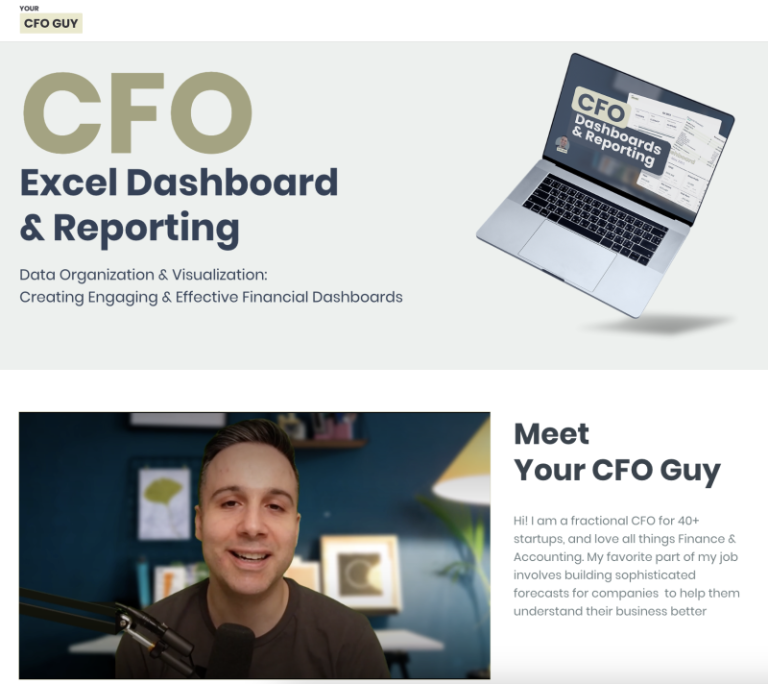
Josh Aharonoff – CFO Excel Dashboard & Reporting
CFO Excel Dashboard & Reporting gives you a guided path from setup to finished dashboards. First, you start with the intro and a clear getting started plan. Then, you build a workflow that stays organized as your files grow. As you progress, you turn raw data into summarized financial reports. Finally, you package results into dashboards and management-ready outputs.
What You Get Inside CFO Excel Dashboard & Reporting
You receive a structured lesson sequence with clear topics and outcomes. Moreover, the course moves from data foundations to advanced dashboard builds. It also includes practical build steps that connect reporting pieces together. You learn through these core stages:
- Intro and setup for the course and your tools
- Data organization, tables, and transformation
- Financial statement reporting and period analysis
- Dashboard design, KPIs, and interactive elements
- Budget vs actual visuals and management reporting
- PivotTable dashboards and specialty dashboards
- Closing guidance to wrap your system
Intro and Getting Started
The course opens with Course Intro, so you know the full roadmap. Next, you set up Your Tech Stack to support the work. After that, you focus on Organizing Your Data, because clean inputs drive clean outputs. Then, you review an Overview to connect the pieces before building.
Organizing Data and Building Strong Tables
CFO Excel Dashboard & Reporting emphasizes structure early, so later steps feel easier. First, you create tables and add additional context in the first video. Next, you continue the same topic in the second video for deeper coverage. Then, you use PowerQuery to transform your data, which helps you standardize messy inputs. As a result, you prepare datasets that behave well in dashboards and reports.
Creating Summarized Financial Reports
After you shape the data, you move into Creating Summarized Financials Report. Next, you handle Setting Dates, because timing drives financial analysis. Then, you build key statements in a clear order. You cover Profit & Loss, and then you build a Balance Sheet. After that, you add Cash Flows to complete the core set. Also, you include Custom periods & sections to match how leaders review performance. Finally, you practice Measuring Period over Period Changes to compare results over time.
Creating Dashboards in Excel
Next, you begin the dashboard track with Creating Dashboards. First, you focus on Getting Data Ready for Dashboards, so visuals update correctly. Then, you build Creating Date Selectors to make dashboards more usable. After that, you create your first KPI, which anchors the story. Next, you work on Finishing the KPI dashboard for a polished result. Then, you create a KPI Dashboard with a graph for quick trend reading. Also, you build a dynamic version using a spill array linked to a chart. Therefore, your KPI view can update smoothly as data expands.
Budget vs Actuals Dashboards
CFO Excel Dashboard & Reporting also covers budget variance reporting with a clear three-part build. First, Budget vs Actuals pt I focuses on designing your tables. Next, Budget vs Actuals pt II builds Gauge charts for visual comparison. Then, Budget vs Actuals pt III finalizes the design for a complete dashboard section. As a result, you can show performance gaps quickly and consistently.
Management Report and Cash Out Dashboard
After you build dashboards, you move into Management Report topics. Then, you create a Cash Out Dashboard to focus on cash movement views. Next, you learn Creating a Cover Page in Excel, which improves presentation quality. Therefore, your reporting package looks more complete and easier to share.
PivotTable Dashboards and Specialized Views
The course also teaches dashboard creation using PivotTables for flexible reporting. First, you create dashboards using PivotTables as a core method. Next, you build a PivotTable Profit & Loss for structured summary views. Then, you add Pivot Charts to visualize pivots with speed. After that, you build a Break Even Dashboard for a focused performance lens. Also, you create a Spotlight Dashboard in two parts. Spotlight Dashboard Pt I pulls in the data for the model. Then, Spotlight Dashboard Pt II designs the dashboard for clear delivery.
Closing Remarks and Next Step
The course ends with Closing Remarks, so you can wrap your system with confidence. If you want broader Excel mastery too, visit Josh Aharonoff – Everything You Can do in Excel Course to expand beyond CFO Excel Dashboard & Reporting.
Sales Page
Download Link for VIP Membership Users:

About The Author