
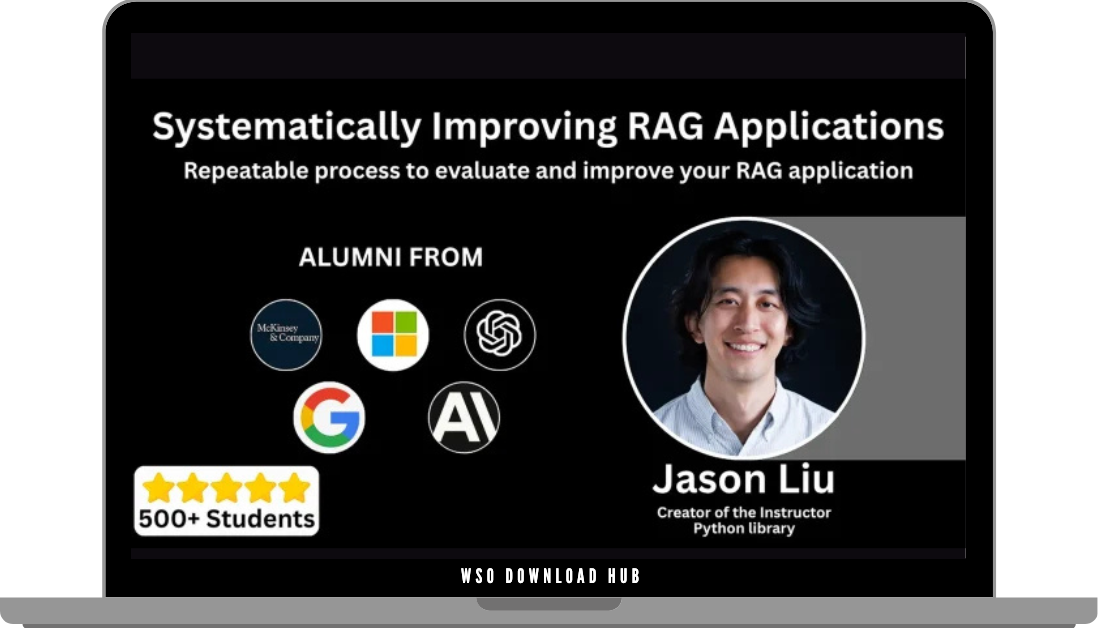
Introduction to Systematically Improving RAG Applications
Systematically Improving RAG Applications provides a transformative guide for building reliable retrieval-augmented generation (RAG) systems. Many RAG implementations struggle to go beyond impressive demos, often failing when challenged with complex queries in real-world applications. This course is designed to address these challenges by helping developers create systems that perform exceptionally well in production environments. By adopting a data-driven and systematic approach, this program ensures that RAG applications continuously improve and deliver measurable business value.
The Reality of RAG Implementation
Many RAG systems face significant challenges when transitioning from prototypes to production. Developers often experience:
- Hallucinations in real-world queries: While demos look promising, real users face inaccurate results when precision matters most.
- Inefficient troubleshooting efforts: Engineers spend hours tweaking prompts without noticeable improvements.
- Manual workarounds: Users often find themselves retrieving information manually that the system failed to deliver.
- Unmeasurable progress: Many teams struggle to evaluate whether their updates are genuinely improving the system.
- Trial-and-error improvements: Without a systematic methodology, improvements feel like guesswork instead of deliberate progress.
- Unclear priorities: Teams lack clarity on which enhancements yield the most value.
These issues often result in wasted time, frustrated users, and lost trust in the system. However, with a structured approach, RAG systems can be transformed into reliable tools.
What a RAG System Should Deliver
Systematically Improving RAG Applications focuses on building systems that:
- Retrieve accurate information, even for complex or ambiguous queries.
- Continuously improve based on user interactions and feedback.
- Provide clear metrics to track progress and demonstrate ROI to stakeholders.
- Adapt to various content types using specialized capabilities.
- Deliver compounding value over time through systematic enhancements.
By addressing these aspects, the course ensures RAG systems are more than prototypes—they become mission-critical tools.
The Key Features of the Course
This program stands out by offering a systematic, data-driven approach to improving RAG systems. Unlike courses that focus solely on technical implementation, Systematically Improving RAG Applications provides frameworks that guide users from prototypes to production-ready solutions.
The Improvement Flywheel
The course introduces the Improvement Flywheel, a methodology that builds synthetic evaluation data to identify system failures before user interactions. This proactive approach ensures developers know exactly where their system falls short and how to fix it.
Fine-Tuning Framework
Participants learn to create custom embedding models using minimal data—sometimes with as few as 6,000 examples. This framework allows developers to fine-tune their systems for domain-specific accuracy improvements, often achieving gains of 20-40%.
Feedback Acceleration
The program emphasizes designing interfaces that collect five times more feedback without frustrating users. By leveraging every user interaction as a signal for improvement, the system strengthens itself over time.
Segmentation System
A query segmentation system helps developers identify which areas require specialized retrievers. This targeted approach can deliver accuracy improvements of 20-40% by focusing resources on the most impactful features.
Multimodal Architecture
The course also delves into implementing multimodal architectures. This involves creating specialized indices for different content types, such as documents, tables, and images, which enhances the retrieval process.
Query Routing
An intelligent query routing system ensures users experience seamless interactions, with the system automatically selecting the optimal retriever for each query. This eliminates fragmentation and creates a more unified experience.
Week-by-Week RAG Implementation Framework
The program is structured into a six-week framework, with each week addressing a specific aspect of RAG improvement:
- Week 1: Evaluation Systems
Build synthetic datasets to pinpoint system failures and measure progress accurately. - Week 2: Fine-Tune Embeddings
Customize embeddings for domain-specific accuracy with minimal examples. - Week 3: Feedback Systems
Design interfaces to gather meaningful user feedback without causing frustration. - Week 4: Query Segmentation
Identify high-impact improvements and prioritize engineering resources effectively. - Week 5: Specialized Search
Build indices for diverse content types to improve precision in complex retrieval scenarios. - Week 6: Query Routing
Implement intelligent routing systems for seamless user experiences and optimized retrieval.
Real-World Results from Systematic Improvements
The methodologies taught in Systematically Improving RAG Applications have proven their effectiveness in real-world scenarios:
- An 85% blueprint image recall for a construction company using visual LLM captioning.
- A 90% retrieval rate for research reports through advanced text preprocessing.
- A $50 million revenue increase for a retail company by fine-tuning product search embeddings.
- A 14% accuracy boost achieved by fine-tuning cross-encoders with minimal data.
- A 30% reduction in irrelevant documents through better query segmentation.
These results demonstrate the tangible impact of a systematic approach to RAG development.
Why This Course Is Unique
This program focuses not just on technical skills but on creating systems that align with business goals. It equips developers with tools to measure progress, prioritize resources, and deliver consistent improvements. The step-by-step frameworks make even complex methodologies accessible, ensuring participants gain skills that translate into measurable results.
Final Thoughts
Systematically Improving RAG Applications provides a roadmap for transforming RAG prototypes into production-ready systems that deliver real business value. By focusing on evaluation, fine-tuning, and user feedback, the course helps developers build systems that adapt and improve over time. The methodologies taught are not just theoretical but proven to drive impactful results across industries.
If you’re interested in using AI to enhance other professional skills, consider exploring Guillermo Rubio (AWAI) – How to Use the Power of AI to Become a Better, Faster, and Higher-Paid Writer. This program complements the technical strategies in Systematically Improving RAG Applications by showcasing how AI can improve creative and professional outcomes.
Sales Page
Download Link for VIP Membership Users:

About The Author

![[Marketing] 1099+ Ultimate ChatGPT Marketing Prompts To Copy & Paste (200+ tasks)](https://wsodownloadhub.com/wp-content/uploads/2024/05/Marketing-1099-Ultimate-ChatGPT-Marketing-Prompts-To-Copy-Paste-200-tasks-Download-300x300-1.webp)