
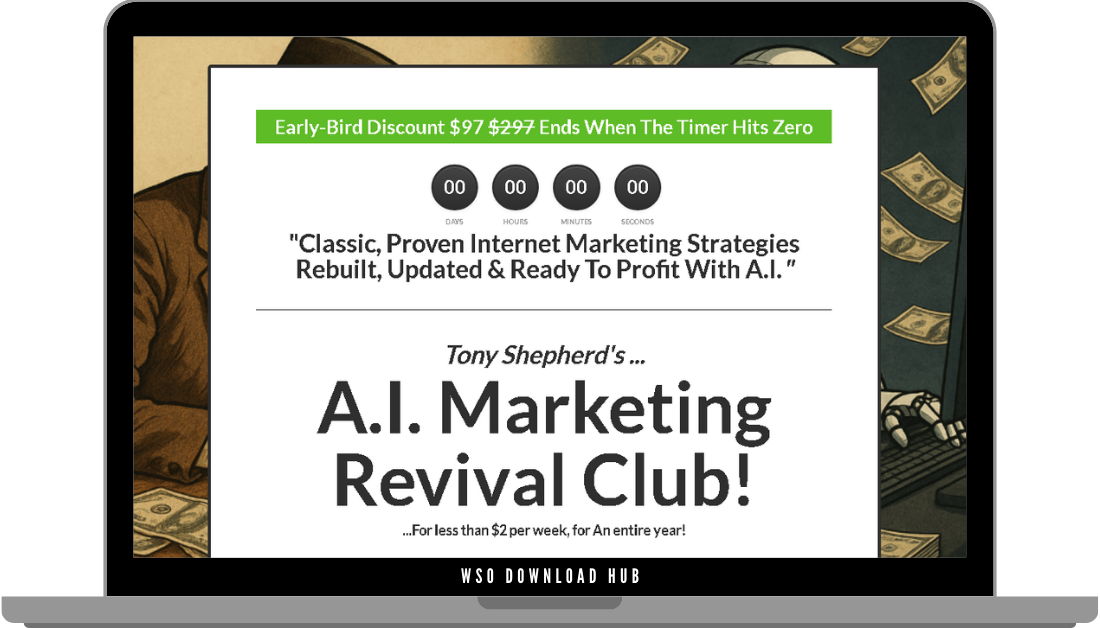
A.I. Marketing Revival Club WhiteLabel – Issue 3: The AI Pre-Sell Revival Mindset
Pre-selling used to separate profitable marketers from hopeful ones. It rewarded evidence over excitement. Therefore, it helped you test demand before building anything. It also helped you test angles and pricing early. As a result, you made smarter bets with fewer regrets.
A.I. Marketing Revival Club WhiteLabel – Issue 3 brings this skill back. However, it updates the process for today. You can now test quietly, faster, and with far less risk.
Why Pre-Selling Mattered in the First Place
In the early days, many marketers worked backwards. First, they created a sales page for a product. Then they sent traffic to that page. Next, they added a buy button.
Sometimes the button led to a simple message. The message said the product was being finalized. Other times, they took payment and built fast. Either way, the rule stayed simple. Test demand before you build.
Pre-selling protected you from three expensive mistakes:
- Building something nobody wants
- Choosing a weak angle that blends in
- Pricing based on guesses instead of proof
For example, a page might get 200 views and zero clicks. That result tells you a lot. Consequently, you can drop the idea without wasting weeks.
Why Pre-Selling Quietly Disappeared
Pre-selling did not stop working. Instead, the environment changed. Because of that, many people stopped testing.
Traffic got expensive
Early clicks often cost very little. Later, meaningful testing required bigger budgets. Therefore, a failed test felt painful and risky.
Tests became public
A pre-sell page still looks like a real launch. So your audience might react in real time. Competitors might also notice your direction. As a result, failure feels public and permanent.
Funnels became complex
A simple page used to be enough. Then funnels grew into multi-step systems. You might need forms, sequences, and extra pages. Consequently, testing started to feel like a full build.
Discipline felt uncomfortable
Pre-selling forces honesty. You must kill ideas that do not show promise. However, many creators fall in love with their concepts. So they avoid tests and hope harder.
What AI Changes in A.I. Marketing Revival Club WhiteLabel – Issue 3
AI cannot predict guaranteed winners. It also cannot replace real buyers. Still, it can simulate buyer reasoning. Therefore, it can surface objections, gaps, and weak assumptions fast.
Think of the shift like this. Old pre-selling tested reactions through traffic. AI pre-selling tests reasoning through structured skepticism. As a result, you can fix obvious issues earlier.
You get a private focus group
AI lets you test ideas without public exposure. You do not need ads to start learning. You also avoid broadcasting half-baked offers. That privacy removes pressure and ego.
You reduce cost and increase speed
Traffic costs money. Audience attention also costs trust. Meanwhile, an AI subscription costs far less than ad testing.
You can also iterate quickly. The old loop took days or weeks. With AI, you can run a solid test in minutes. Therefore, you explore more options with less risk.
The Three Questions Every Pre-Sell Must Answer
A.I. Marketing Revival Club WhiteLabel – Issue 3 uses a simple framework. Every offer must answer these questions clearly:
- Is the problem real enough and urgent enough?
- Is the angle distinctive enough to stand out?
- Is the price defensible with your value and proof?
You can still validate with real sales later. However, this framework filters weak ideas first. So you build fewer offers, yet stronger ones.
Ask Better Questions Than Will This Sell
Many people ask AI, will this sell. That question creates soft, generic answers. Instead, ask questions that expose resistance. Resistance shows you what needs work.
Use prompts like these:
- What objections would a skeptical buyer raise?
- What makes this feel interesting but unnecessary?
- What assumptions am I making about the buyer?
- What alternatives will they compare this to?
These questions force clarity. Then you can adjust the offer or drop it.
The indifference test that kills offers
Disagreement does not end most sales. Indifference ends them. People often think, sounds nice, not now. Therefore, you must uncover what makes your offer feel optional.
Ask AI what would make buyers delay. Then tighten your promise, proof, or urgency.
The assumption check
Every offer assumes something about the buyer. It assumes what they know. It also assumes what they value. If those assumptions fail, your offer fails too.
So ask AI to list your hidden assumptions. Then decide if you target a narrower segment. Or rewrite the promise to match reality.
The comparison question
Buyers compare everything. They might compare you to free videos. They might compare you to a book. They might compare you to doing nothing.
Once you know the comparison, you can position clearly. You can also show why your path saves time or reduces risk.
Stress-Testing Angles Without Writing Full Copy
Most angles fail quietly. People nod and move on. Therefore, you should test angles before writing long pages.
Start with two or three angles for one offer. Then ask AI which angle creates curiosity. Next, ask which angle feels credible. Also ask which angle feels most relevant. Finally, ask which angle feels unnecessary.
That last question hurts, yet it helps. It shows which angle blends into the crowd.
Then run a friction test. Ask where someone might hesitate with each angle. If the friction lives inside the angle, replace it. If the friction comes from clarity, add proof later.
Also use the yeah, but test. For each angle, ask what yeah, but response appears. That response points to your weak spot.
Validating Pricing Without Public Experiments
Pricing errors happen early. Many people pick a number that feels right. Then they build around it. Later, they panic when sales look weak.AI cannot choose the perfect price. Pricing depends on market context and trust. However, AI can pressure-test your pricing logic. So you avoid fragile numbers.
Ask these three pricing questions:
- What would make this feel overpriced?
- What assumptions does this price rely on?
- What will buyers compare this to?
You can also run a price ladder test. Compare what $27, $97, and $297 require. Lower prices demand speed and simplicity. Higher prices demand clearer transformation and stronger proof. Therefore, you match price to delivery instead of mood.
What This Method Does Not Replace
AI helps you think more clearly. It does not replace customers. It also does not replace real validation through sales.
Instead, it acts like a filter. Without a filter, you might build ten ideas. With a filter, you build three better ideas. As a result, your odds improve and your stress drops.
Still, you must keep your judgment. AI may miss market fatigue signals. It may also miss what your audience already tried. Therefore, treat it as a thinking partner, not a decision-maker.
Common Mistakes to Avoid
Most failures come from simple missteps. So keep your process clean.
- You ask vague questions and get vague answers.
- You trust AI too much and stop thinking.
- You skip real validation after the AI stage.
- You overcomplicate prompts and stall execution.
- You use testing as procrastination instead of progress.
Keep it simple. Describe the offer. Ask a few sharp questions. Then decide and move.
Where to Use This in Your Current Process
You do not need a full rebuild. You can add AI pre-selling to what you already do.
Before you build, test the problem, angle, and price. Before you write copy, surface objections and comparisons. Before you launch, stress-test the offer for weak points.
This approach supports both launches and evergreen funnels. Consequently, you spend less time patching obvious leaks later.
If you want another AI-driven income resource next, you can also explore Paul James – Passive AI Money Machines for additional ideas that pair well with this mindset.
Download Link for VIP Membership Users:

About The Author