

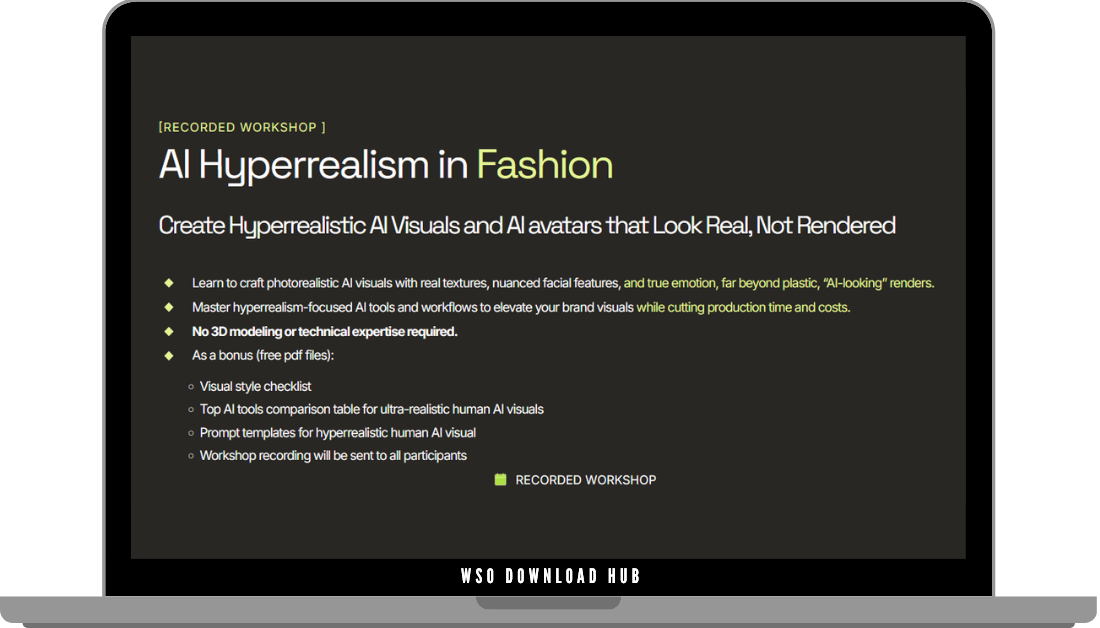
AI Hyperrealism in Fashion Workshop Review: Create Realistic Fashion Visuals With AI
Fashion visuals need emotion, texture, and detail to feel believable. However, many AI images still look too smooth, plastic, or artificial. That can make brand visuals feel less premium.
AI Hyperrealism in Fashion Workshop helps creators build more realistic AI fashion images. The workshop focuses on photorealistic visuals, natural faces, real textures, and emotional expression. Therefore, learners can create fashion content that looks more refined and professional.
This workshop from Olska Green teaches AI workflows for people who want high-quality visual output. It also helps reduce production time and creative costs. As a result, fashion brands and creators can produce stronger visuals without complex technical skills.
What Is AI Hyperrealism in Fashion Workshop?
AI Hyperrealism in Fashion Workshop is a creative training program for fashion-focused AI visuals. It teaches learners how to move beyond generic AI renders. Instead, students learn how to create images with realistic skin, fabric, lighting, mood, and expression.
Many AI visuals fail because they lack human depth. Faces may look flat, clothing may feel fake, and emotion may seem forced. However, strong hyperrealistic workflows can improve those details.
This workshop helps learners understand how to guide AI more effectively. It focuses on tools, prompts, visual direction, and quality control. Because of that, users can create more polished results for fashion campaigns, brand content, and creative projects.
No 3D modeling experience is required. Learners also do not need advanced technical expertise. This makes the workshop approachable for designers, marketers, creators, and fashion business owners.
Why Hyperrealistic AI Fashion Visuals Matter
Fashion depends on visual trust. People need to see texture, fit, mood, and styling clearly. If an image feels fake, it may reduce emotional connection.
AI Hyperrealism in Fashion Workshop helps solve this problem by focusing on believable detail. It teaches how to create visuals that feel closer to real photography. This can help brands produce content that looks more natural and premium.
Hyperrealism also supports faster content creation. Traditional shoots can require models, locations, photographers, styling, and editing. AI workflows can reduce some of those steps when used correctly.
However, quality still matters. AI images need direction, review, and refinement. Therefore, this workshop focuses on realistic output instead of quick but weak results.
What You Learn Inside AI Hyperrealism in Fashion Workshop
The workshop teaches practical skills for creating realistic human AI visuals. Each part supports better image quality and stronger fashion presentation. Learners can use the training to improve both creative control and workflow speed.
Inside the workshop, learners can study:
- How to create photorealistic AI fashion visuals
- How to improve facial details and natural expressions
- How to make textures look more realistic
- How to avoid plastic or artificial-looking renders
- How to use hyperrealism-focused AI tools
- How to build workflows that save production time
- How to create brand visuals without 3D modeling
These lessons help learners create images with more depth. They also support better creative decisions during prompt writing and image selection.
Real Textures, Natural Faces, and True Emotion
Small details often decide whether an AI image feels real. Skin texture, fabric folds, eye expression, and lighting all matter. Without these details, even a stylish image can look artificial.
AI Hyperrealism in Fashion Workshop teaches learners how to focus on those quality signals. It helps them create visuals with nuanced facial features and believable emotion. This makes the final output feel more human.
Fashion visuals also need strong material realism. A silk dress should not look like plastic. Denim should show weight, weave, and structure. Therefore, texture control becomes an important part of the workflow.
When these elements work together, AI fashion visuals can look more editorial. They can also support brand storytelling with greater impact.
Bonus Resources Included
The workshop also includes useful bonus PDF files. These resources help learners apply the training more easily. They can also support future projects after the workshop ends.
The bonus materials include:
- A visual style checklist
- A top AI tools comparison table for realistic human visuals
- Prompt templates for hyperrealistic human AI visuals
The visual style checklist can help learners review their image quality. The tools comparison can guide better software choices. Meanwhile, the prompt templates can reduce blank-page stress during creation.
These resources make the workshop more practical. Learners can use them as references while building new fashion visuals.
Who Should Join AI Hyperrealism in Fashion Workshop?
AI Hyperrealism in Fashion Workshop can help fashion creators who want better AI visuals. It may also support designers, stylists, brand owners, marketers, and content creators. Anyone who needs high-quality fashion imagery may find value here.
This workshop may fit you if you want to:
- Create realistic AI fashion images
- Improve brand visuals without costly shoots
- Learn AI tools for hyperrealistic human visuals
- Use prompt templates for better image direction
- Reduce production time while improving quality
- Avoid generic AI-looking renders
The workshop works best for learners who care about visual quality. It can help users move from basic AI images to more polished fashion content.
Why AI Hyperrealism in Fashion Workshop Stands Out
Many AI image courses teach basic prompting. However, this workshop focuses on realism in a fashion context. That makes it more specific and useful for visual brands.
AI Hyperrealism in Fashion Workshop also removes the need for complicated 3D tools. Learners can focus on AI workflows, style direction, and image quality. This makes the process easier for non-technical creatives.
The bonus templates and checklist also add practical support. They help users create better results with less trial and error. As a result, the workshop can save both time and creative energy.
Most importantly, the course helps learners understand what makes an AI visual feel human. That skill matters in fashion, where emotion and detail create desire.
Final Thoughts on AI Hyperrealism in Fashion Workshop
AI Hyperrealism in Fashion Workshop gives creatives a practical way to build realistic AI fashion visuals. It focuses on photorealism, real textures, facial nuance, emotional detail, tools, and prompt workflows.
The workshop can help fashion brands and creators improve visual production while reducing time and costs. It also suits learners who want professional-looking results without 3D modeling skills. While outcomes depend on practice, the training provides a strong creative foundation.
For more fashion, AI, and creative learning resources, visit WSO Download Hub and explore practical programs for online growth. You can also browse WSO Downloads to discover more courses across design, fashion, AI, content, and digital business.
If you want to expand your fashion business knowledge after studying AI Hyperrealism in Fashion Workshop, explore David Kollar – Fast-Track Fashion Academy Elite. It can help you build stronger fashion brand strategy, product direction, and business growth skills alongside your AI visual creation workflow.
Sales Page
Download Link for VIP Membership Users:

About The Author







![[Full Course] Udemy - 100 Days of Code The Complete Python Pro Bootcamp](https://wsodownloadhub.com/wp-content/uploads/2024/11/Full-Course-Udemy-100-Days-of-Code-The-Complete-Python-Pro-Bootcamp.png)