
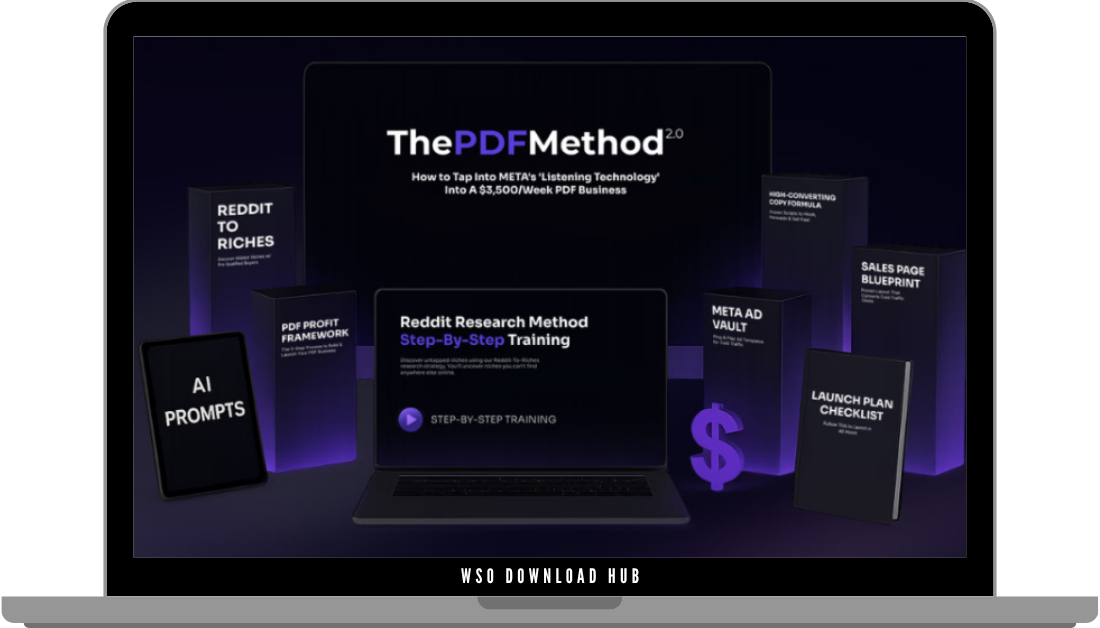
What Is PDF Method 2.0?
PDF Method 2.0 is a structured training program from Ewan Davies focused on building a business around digital PDF guides. The course covers the complete process, from researching market demand to creating, selling, delivering, and scaling digital products.
Instead of creating a guide first and hoping people want it, the method starts with market research. This demand-first approach helps learners identify problems that potential customers already want to solve.
From there, the training introduces AI-assisted content creation, PDF design, sales pages, Meta advertising, and automated delivery. Finally, learners study campaign data to decide whether they should optimize, scale, or explore another opportunity.
How the PDF Method 2.0 System Works
The core strategy follows six connected stages. Each stage supports the next, creating a repeatable workflow for launching digital PDF products.
1. Research a Market With Existing Demand
The first stage focuses on finding a suitable niche rather than choosing one based only on personal interests. Learners research conversations and recurring problems within online communities.
Reddit plays an important role in this research process. Meanwhile, AI can help organize findings and identify recurring themes across audience discussions.
This process aims to uncover problems that people actively discuss and seek help solving. Therefore, product creation begins with evidence of interest rather than assumptions.
2. Understand the Target Customer
Finding a promising topic alone does not create a strong offer. You also need to understand the people experiencing that problem.
PDF Method 2.0 explores audience pain points, goals, concerns, and the language customers use when describing their situations. These insights can then shape both the product and its marketing.
As a result, the PDF can address a more specific need. The sales message can also communicate the solution in language that feels relevant to the intended audience.
3. Create a Useful PDF With AI Assistance
Once the topic and audience become clear, the next stage involves developing the actual digital guide. AI supports research, organization, outlining, and content development throughout this process.
The objective is not simply to generate large amounts of text. Instead, learners focus on organizing useful information around a defined customer problem.
A concise guide can still provide meaningful value when it offers clear steps and practical explanations. Therefore, usefulness matters more than unnecessary length.
The training also covers how to structure information logically. This helps readers move from understanding their problem toward taking practical action.
Designing a Professional Digital Product
Content quality matters, but presentation also shapes the reader’s experience. For that reason, the course includes a dedicated section on PDF design.
Learners explore straightforward workflows for organizing pages and improving visual presentation. Clear formatting can make information easier to scan, understand, and apply.
Good design also helps the finished guide feel more complete and organized. However, the process does not require complicated visual production.
The goal is to combine useful information with a polished reading experience. Consequently, creators can focus on clarity without turning design into an unnecessary obstacle.
Building a Sales Page Around the Customer’s Problem
After creating the product, learners need a clear way to present it to potential buyers. The course therefore covers sales page structure and messaging.
The training focuses on connecting the customer’s current problem with the solution offered by the PDF. It also explores how to communicate benefits clearly without relying on complicated copywriting.
Templates and structured frameworks help organize the page. This gives learners a starting point instead of requiring them to build every section from scratch.
More importantly, the earlier audience research supports this stage. Strong customer insights can guide headlines, benefits, positioning, and other important sales messages.
Using Meta Ads to Reach Potential Buyers
Paid traffic forms another important part of the system. PDF Method 2.0 introduces Meta advertising as a way to reach relevant audiences.
The advertising approach centers on simple creative concepts and direct messaging. Ads should connect with the problem discovered during the initial research phase.
Learners can then test campaigns and observe how real audiences respond. Therefore, advertising becomes both a customer acquisition channel and a source of market feedback.
However, paid advertising always involves financial risk. Results can vary according to the offer, creative quality, targeting, costs, and market conditions.
For that reason, testing and data analysis remain essential. A structured process helps learners make decisions based on performance rather than assumptions.
Automating PDF Delivery
Digital products offer an important operational advantage because fulfillment can run automatically. Once someone completes a purchase, the delivery system can provide access without manual intervention.
The course explains how to create this automated workflow. As a result, creators do not need to send each purchased PDF individually.
Automation also makes the model easier to repeat across multiple products. Each guide can operate through a similar sales and delivery structure.
However, automation does not remove the need for monitoring. Creators still need to review customer experience, advertising performance, and technical reliability.
Launching, Measuring, and Scaling
The final stage brings the previous components together into a complete launch. Learners move from research and creation into real campaign testing.
At this point, data becomes especially important. Campaign performance can reveal whether an offer deserves further investment or needs improvement.
Learners study the numbers before deciding their next move. If a campaign performs well, they can consider increasing its reach gradually.
If results remain weak, they can examine the offer, advertising, audience, or positioning. Alternatively, the research may reveal that another niche offers stronger potential.
This repeatable process makes the model broader than launching one PDF. The same framework can support additional guides across different customer problems and markets.
What the Eight-Module Curriculum Covers
The course organizes its material into eight modules that follow the business-building process in sequence. This structure helps learners progress from initial research toward launch and optimization.
- Module 1: Research profitable niches and identify existing market demand.
- Module 2: Study target audiences, problems, motivations, and relevant messaging.
- Module 3: Use AI to develop structured and useful PDF content.
- Module 4: Improve presentation through practical PDF design principles.
- Module 5: Build a sales page that clearly presents the offer.
- Module 6: Create an automated system for digital product delivery.
- Module 7: Develop Meta ads designed around customer problems and interests.
- Module 8: Launch campaigns, evaluate performance, and scale promising opportunities.
Because these modules follow a logical sequence, learners can build each component before moving forward. This reduces the need to assemble disconnected tactics independently.
Who May Benefit From PDF Method 2.0?
PDF Method 2.0 may suit beginners who want a structured introduction to creating and marketing simple digital information products.
It may also interest marketers who want to test product ideas without developing complex software or large online courses. Likewise, existing creators can use the framework to explore additional digital offers.
However, learners should understand that the model involves more than creating PDFs with AI. Market research, positioning, advertising, testing, and optimization all influence the outcome.
Therefore, success depends on execution and continued improvement. Neither automation nor AI removes the need for thoughtful business decisions.
Why Demand-First Product Creation Matters
One of the strongest concepts behind the method is its order of operations. Research comes before product creation.
This distinction matters because creators often spend considerable time developing products before confirming whether meaningful demand exists.
By researching real audience conversations first, learners can identify recurring questions and unresolved problems. They can then create products around clearer market signals.
AI can accelerate parts of this process, but human judgment remains important. Creators still need to evaluate whether the information is accurate, useful, and appropriate.
Therefore, the overall workflow combines research, technology, marketing, and measurement rather than depending on a single shortcut.
Final Thoughts on PDF Method 2.0
PDF Method 2.0 presents a practical framework for turning researched problems into marketable digital guides. It connects niche research, audience analysis, AI-assisted creation, design, sales pages, advertising, delivery, and scaling.
The system also provides a repeatable process rather than focusing on one product idea. Once learners understand the workflow, they can apply similar principles when evaluating future PDF opportunities.
If you want additional resources covering digital products, marketing, AI, and online business, explore WSO Download Hub. You can also browse WSO Downloads to discover more programs focused on digital marketing, business systems, content creation, and entrepreneurship.
If you want to explore another approach to building and monetizing PDF-based digital products, consider Sean Anthony – PDF Profits Protocol. It complements PDF Method 2.0 with another perspective on creating, positioning, and marketing PDF offers. Studying both approaches can broaden your understanding of digital product research, customer acquisition, automated delivery, and scalable PDF business systems.
Sales Page
Download Link for VIP Membership Users:

About The Author