
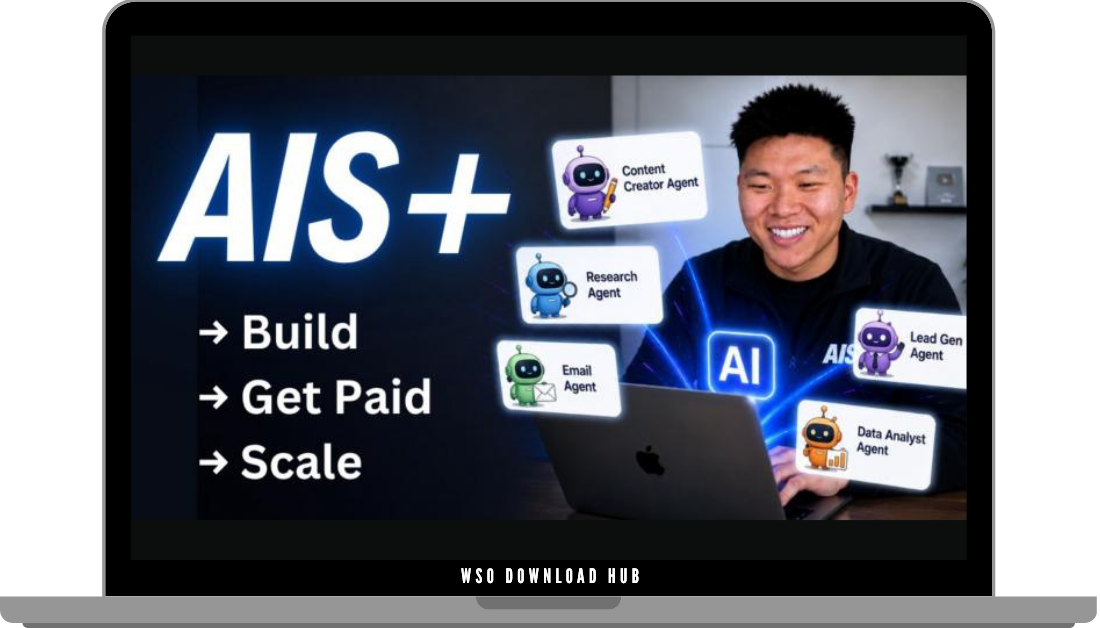
Nate Hark – AI Automation Society Plus
AI Automation Society Plus is a practical learning program focused on building an AI automation business from the ground up. The training connects technical skills with client acquisition and agency development. Therefore, members learn more than how to create automations. They also explore how those skills can become valuable services for real businesses.
The program follows a progressive path that moves from building practical projects toward finding clients and developing scalable operations. This structure gives learners clear milestones instead of presenting disconnected tutorials without a broader business direction.
What Is AI Automation Society Plus?
AI Automation Society Plus combines hands-on AI automation education with an agency-focused business framework. It targets learners who want to turn technical capabilities into services that solve practical business problems.
Rather than focusing entirely on individual tools, the program emphasizes implementation. Members work through projects, build experience, and develop examples they can potentially show prospective clients.
Moreover, the curriculum introduces business development in stages. This approach allows learners to establish useful skills before concentrating heavily on client acquisition and growth.
A Three-Phase Path From Skills to Business
The learning journey follows three broad stages: building, getting clients, and scaling. Each phase addresses a different challenge that aspiring AI automation professionals commonly face.
First, learners need practical abilities and examples of their work. Next, they need a process for connecting those capabilities with paying clients. Finally, they need systems that can support a growing business.
This progression creates a logical path from education toward implementation. It also helps prevent beginners from focusing on advanced scaling before establishing the necessary foundation.
Build Practical AI Automation Skills
Understanding automation theory can be useful, but clients generally need solutions to real operational problems. Therefore, hands-on project work forms an important part of the learning experience.
Practical projects can help learners understand how different components work together within an automation. They also provide opportunities to troubleshoot problems and improve implementation skills.
Through repeated practice, members can develop stronger confidence in areas such as:
- Planning useful AI-powered workflows.
- Connecting tools within automated processes.
- Understanding practical business use cases.
- Testing and improving automation projects.
- Presenting completed work to potential clients.
This project-oriented approach connects technical learning with the needs of an actual service business.
Develop a Portfolio Before Seeking Clients
Potential clients often want evidence that a service provider can deliver useful results. However, beginners usually face a common problem. They need experience to attract clients, yet they need clients to gain experience.
The portfolio-building stage helps address this challenge through practical project development. Learners can create examples that demonstrate their understanding of automation and business workflows.
A portfolio also makes conversations with prospects more concrete. Instead of discussing abstract capabilities, service providers can demonstrate how automation concepts work in practice.
The AI Partner Business Model
The program introduces an AI partner approach rather than focusing only on isolated technical projects. This model emphasizes developing deeper relationships with businesses that need ongoing automation support.
Companies rarely have just one process that could benefit from improvement. As their operations evolve, new opportunities for automation can appear across marketing, sales, support, and internal workflows.
Therefore, an ongoing partnership can create more value than completing unrelated one-time tasks. The service provider gains deeper business knowledge while the client receives continued technical support.
Moving From Projects to Paying Clients
Technical ability alone does not automatically create an agency. Service providers also need to identify suitable prospects and communicate the value of their solutions.
AI Automation Society Plus connects the portfolio stage with a later client acquisition phase. This sequence encourages members to develop practical capabilities before approaching businesses with their services.
When discussing automation, successful communication should focus on business outcomes rather than technical complexity. Clients usually care more about solving problems than understanding every tool behind the solution.
Consequently, learners need both implementation skills and the ability to connect those skills with meaningful business needs.
Why Long-Term Client Relationships Matter
A service business built entirely around one-time projects must continually replace completed work with new opportunities. That cycle can make revenue less predictable.
Longer client relationships create a different model. An automation partner can continue identifying opportunities, maintaining systems, and improving workflows as business requirements change.
However, recurring relationships require ongoing value. Agencies need reliable delivery, clear communication, and systems that support consistent service over time.
This makes client retention an operational responsibility rather than simply a pricing strategy.
Technical Support and Problem Solving
Automation projects can become complicated when multiple platforms, integrations, and AI tools interact. Even experienced builders occasionally encounter unexpected technical issues.
The program includes technical support designed to help members work through implementation challenges. This support can be particularly useful while learners complete hands-on projects.
Instead of abandoning a project when something fails, members can continue troubleshooting while strengthening their technical understanding.
Over time, solving real problems becomes an important part of developing professional automation skills.
Learn Through Weekly Live Q&A Sessions
Structured lessons provide a foundation, but implementation often creates questions that prerecorded material cannot anticipate. Weekly live Q&A sessions add an interactive element to the learning process.
Members can gain additional context around technical projects, client situations, and business development challenges. Recorded sessions also allow learners to revisit discussions later.
This combination of structured education and ongoing interaction supports different learning styles while keeping the program connected to practical implementation.
Scaling an AI Automation Business
Landing clients creates a new set of challenges. As workload increases, informal processes can become difficult to manage consistently.
The scaling phase focuses on building stronger business foundations and operational systems. These processes become increasingly important as an agency handles more projects and client relationships.
For example, growth may require clearer workflows for project management, communication, delivery, documentation, and ongoing support.
Without structure, additional clients can create complexity rather than sustainable growth. Therefore, operational development becomes just as important as technical expertise.
Who Can Benefit From AI Automation Society Plus?
The program may appeal to people who want both technical education and a practical path toward building an automation service business.
Potential participants include:
- Beginners exploring AI automation as a professional skill.
- Freelancers looking to expand their service offerings.
- Agency owners interested in adding AI automation services.
- Technical builders who need stronger client acquisition skills.
- Entrepreneurs seeking a structured automation business model.
However, building an agency requires active implementation. Training can provide frameworks, but learners still need consistent practice and business development effort.
Why Practical Experience Matters
AI tools continue to evolve quickly. As a result, memorizing one platform rarely creates a lasting advantage.
A stronger foundation comes from understanding workflows, solving business problems, and adapting to different technical environments. Practical projects help develop these transferable abilities.
Moreover, real implementation teaches lessons that tutorials cannot fully reproduce. Troubleshooting, client requirements, and changing project conditions all require judgment and adaptability.
This makes hands-on experience an essential bridge between learning automation and providing professional services.
Final Thoughts on AI Automation Society Plus
AI Automation Society Plus combines AI automation training with a structured pathway toward building a service-based business. Its progression covers practical projects, portfolio development, client acquisition, technical support, and longer-term agency growth.
The program may particularly suit learners who want to connect technical AI skills with commercial applications. However, meaningful progress still depends on consistent implementation, problem solving, and client-focused execution.
For more resources covering AI, automation, digital business, and entrepreneurship, explore WSO Download Hub. You can also browse WSO Downloads for additional training on AI workflows, marketing, agencies, automation systems, and online business development.
If you want to expand your technical knowledge beyond the agency-building framework, explore Fabian Markl – AI Automations, Agents & Webapps. It offers a complementary perspective on building AI automations, intelligent agents, and practical web applications. Combined with AI Automation Society Plus, these concepts can connect technical implementation with portfolio development, client services, and scalable AI business opportunities.
Sales Page
Download Link for VIP Membership Users:

About The Author