
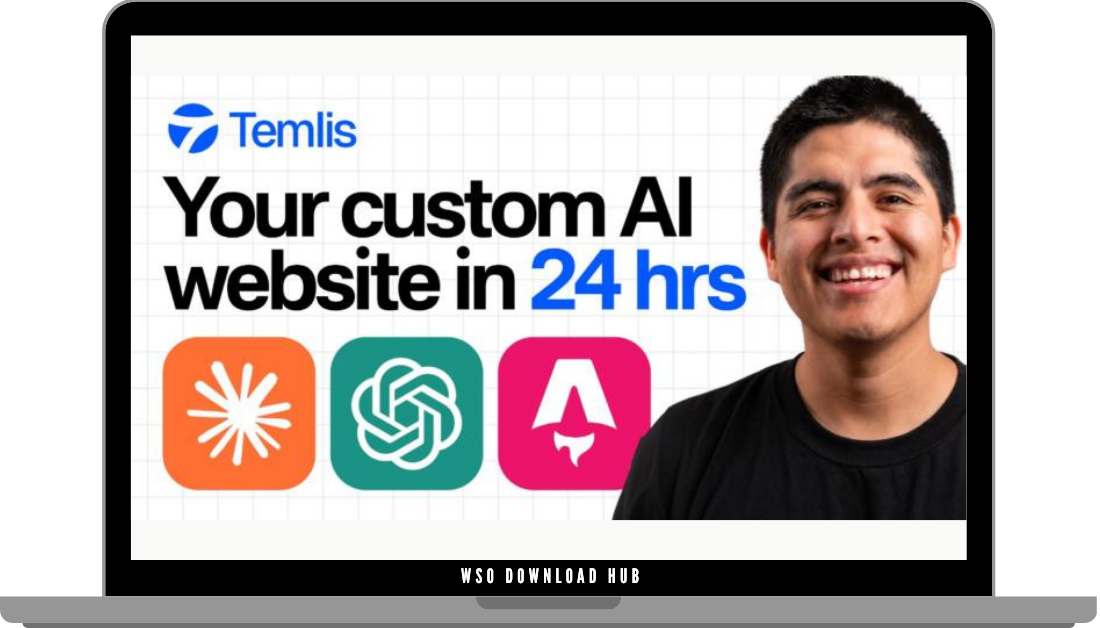
Temlis – AI Website School
AI Website School is a practical learning system for building modern websites with AI-assisted workflows, Figma resources, and reusable components. It combines design foundations with Claude-based automation to create a more efficient path from visual concept to functional website.
The program serves beginners, freelancers, and agencies with different levels of experience. Moreover, its guided approach helps learners understand where to begin instead of navigating disconnected tools without a clear workflow.
What Is AI Website School?
AI Website School focuses on improving how designers and developers approach website production with artificial intelligence. Rather than depending entirely on manual coding, learners explore workflows that connect design resources with AI-assisted implementation.
The system includes premium Figma and HTML/CSS templates alongside an extensive component and interaction library. Additionally, Claude automation workflows help streamline repetitive development tasks while keeping creators involved in important decisions.
This combination provides a structured foundation for producing websites without starting every project from an empty canvas.
A More Structured Approach to AI Web Design
AI can generate code quickly, but speed alone does not guarantee a polished website. Poor instructions may create inconsistent layouts, weak interfaces, or code requiring extensive correction.
Therefore, a structured workflow becomes important. Designers first need a clear visual foundation before using AI to accelerate implementation.
AI Website School approaches this process by connecting established templates with automation. Consequently, users can begin from a defined design direction and use AI throughout later production stages.
Start With Premium Figma Templates
Starting from a professional template can reduce the time required for early design decisions. It also provides an existing structure for layouts, sections, typography, and visual hierarchy.
The program includes more than 120 Figma and HTML/CSS website templates. These resources can serve as starting points for different projects rather than rigid finished designs.
Users can customize the visual direction according to project requirements. Then, they can move toward implementation without rebuilding common interface structures from scratch.
Explore Thousands of Components and Interactions
Modern websites rely on many reusable interface elements. Navigation systems, buttons, cards, sections, forms, and interactive elements appear repeatedly across different projects.
The included library provides access to more than 2,500 components and interactions. Therefore, creators can assemble interfaces more efficiently while maintaining greater consistency.
A reusable component library can support several practical benefits:
- Faster website prototyping and production.
- More consistent interface patterns.
- Less repetitive design work.
- Greater flexibility across different projects.
- A stronger starting point for customization.
However, components still require thoughtful selection. Designers should choose elements according to user needs rather than adding features simply because they exist.
Use Claude Orchestration for Website Workflows
A major focus of AI Website School involves Claude-powered workflows for assisting website production. The program introduces an orchestration flow designed around practical development tasks.
Instead of treating AI as a simple code generator, orchestration can divide work into clearer stages. This makes the process easier to guide, review, and refine.
Creators can begin with an established design and then use AI assistance during implementation. As a result, they maintain stronger visual direction while reducing repetitive manual work.
Work With Pre-Trained Claude Agents
General AI assistants often require detailed instructions before they understand a specialized workflow. Pre-trained agents aim to provide a more focused starting point for specific tasks.
The program includes Claude Agents designed around website creation workflows. New agents also expand the available options as the learning environment develops.
These agents can support a more organized production process. However, users should still review outputs carefully and make decisions based on each project’s requirements.
AI works best as part of a controlled workflow rather than an unquestioned replacement for human judgment.
Learn Autonomous AI Workflows
Automation becomes more valuable when multiple steps work together instead of requiring constant manual intervention. Autonomous workflows can help connect tasks within a broader production sequence.
This approach may reduce repetitive actions and allow creators to focus on higher-level decisions. For example, they can spend more time refining usability, visual direction, and client requirements.
Nevertheless, automation still requires oversight. Testing and quality control remain essential before deploying any website to real users.
A Guided Roadmap for Beginners
Learning web design can feel overwhelming because many tools compete for attention. Beginners may struggle to decide whether they should learn design, coding, AI, or automation first.
The guided roadmap provides a clearer sequence for developing these skills. Instead of jumping randomly between topics, learners can follow an organized progression.
This makes AI Website School accessible to people without previous experience. They can build foundational knowledge before moving toward more advanced workflows.
How the Website Creation Process Works
The overall workflow follows a practical sequence that connects design selection with AI-assisted development and deployment.
- Choose a suitable Figma template as the visual foundation.
- Customize the design according to the project requirements.
- Use the Claude automation workflow to support implementation.
- Review the website for design, functionality, and responsiveness.
- Deploy the completed website for its intended use.
This process reduces the need to begin every project from scratch. Moreover, it gives creators a repeatable framework they can improve over time.
Benefits for Freelance Web Designers
Freelancers often manage design, development, communication, revisions, and delivery themselves. Consequently, production efficiency directly affects how many projects they can handle.
Templates and reusable components can shorten repetitive stages. Meanwhile, AI workflows can assist with technical implementation and reduce unnecessary manual effort.
Faster production may also create more time for client communication and creative refinement. However, freelancers still need strong quality standards to maintain professional results.
The real advantage comes from improving workflow efficiency without sacrificing the final user experience.
How Agencies Can Use Repeatable Systems
Agencies face similar challenges at a larger scale. As project volume grows, inconsistent processes can create bottlenecks across design and development.
A standardized workflow can help teams establish clearer production stages. Reusable templates and components also reduce the need to rebuild common structures repeatedly.
Furthermore, AI-assisted processes can support greater output without making every task dependent on manual coding. This can help agencies use existing resources more efficiently.
Still, each client requires appropriate customization. Repeatable systems should accelerate production without making every website look identical.
Personal Feedback and Ongoing Q&A
Templates and recorded training cannot anticipate every challenge that appears during real projects. Therefore, access to feedback can provide useful context when learners encounter specific problems.
The program includes personal feedback and Q&A opportunities. This support can help users understand where their workflow, design, or implementation needs improvement.
Feedback also encourages active learning. Instead of only consuming lessons, participants can apply concepts and evaluate their results.
New Templates and Evolving Resources
Web design trends and AI capabilities continue to change. A static resource library can become less useful as tools and expectations evolve.
AI Website School adds new templates over time, while community input helps influence future additions. This approach allows the resource collection to expand around practical user interests.
New pre-trained agents also extend the automation side of the system. Consequently, learners can continue exploring updated workflows as AI-assisted website creation develops.
Who Can Benefit From AI Website School?
The program serves different audiences because its resources cover both foundational learning and production efficiency.
Beginners can use the guided roadmap to develop an organized starting point. Freelancers can focus on improving delivery workflows and expanding their capabilities.
Meanwhile, agencies can explore repeatable systems for handling greater project volume. Designers with existing Figma experience may also use the AI workflows to extend their work into implementation.
Ultimately, the system suits people who want to combine visual design resources with modern AI-assisted web production.
Why Human Design Judgment Still Matters
AI can accelerate many website tasks, but it cannot automatically guarantee a strong user experience. Effective websites still require thoughtful decisions about hierarchy, navigation, accessibility, and visual consistency.
Templates provide a foundation, while automation improves efficiency. However, creators remain responsible for adapting those resources to real users and project goals.
This balance matters because the strongest workflow combines automation with deliberate design choices. Therefore, AI becomes a production advantage rather than a substitute for critical thinking.
Final Thoughts on AI Website School
AI Website School combines Figma templates, reusable components, Claude agents, automation workflows, and guided education within one website creation system. Its approach helps users move from design concepts toward functional websites through a more repeatable process.
The program can support beginners learning modern workflows, freelancers improving delivery, and agencies seeking greater production efficiency. Ultimately, its value lies in connecting design resources with practical AI assistance while maintaining human oversight.
For additional learning around artificial intelligence, design, marketing, and digital business, explore WSO Download Hub. You can also browse WSO Downloads for more programs covering web design, automation, AI workflows, creative skills, and online business development.
If you want to strengthen the visual design skills behind an AI-assisted website workflow, explore Arash Ahadzadeh – UI Design & Figma Mastery. It provides a complementary focus on interface design and practical Figma skills for creating stronger digital experiences. For designers who want to connect those production skills with a structured client-service model, Whitney Rose – One Week Web Designer explores offer positioning, client workflows, project boundaries, and focused website delivery. Together with AI Website School, these resources can help designers connect thoughtful UI design, AI-assisted production, and efficient client delivery within a more complete web design workflow.
Sales Page
Download Link for VIP Membership Users:

About The Author


![[VIP DOWNLOAD] Jack Hopkins – 10K Accelerator Program](https://wsodownloadhub.com/wp-content/uploads/2024/06/Jack-Hopkins-–-10K-Accelerator-Program-Download-300x185-1.png)