

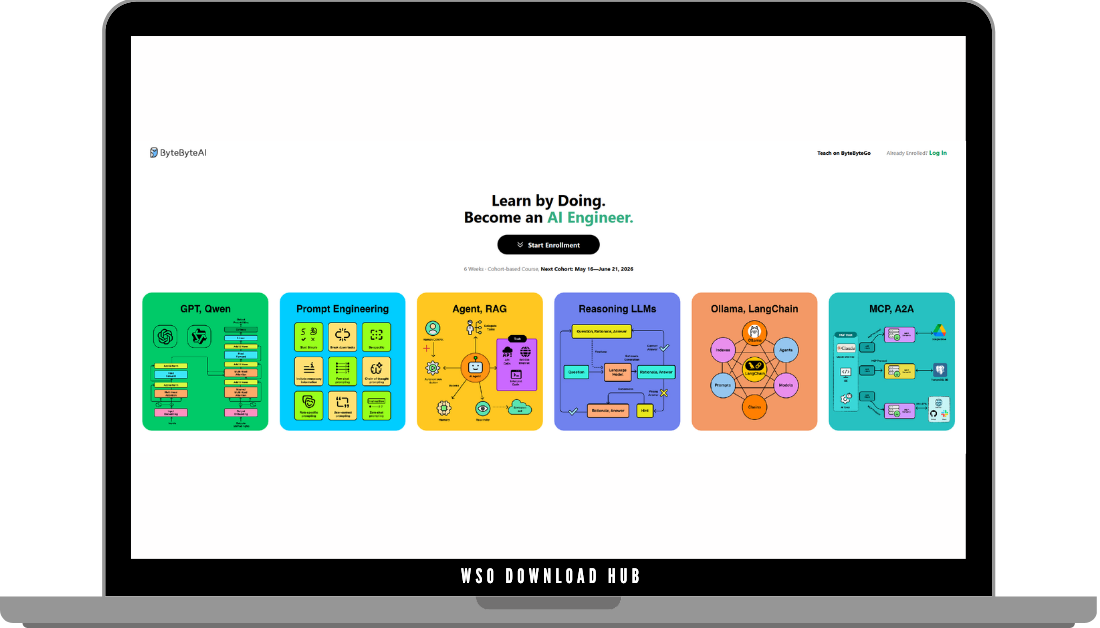
ByteByteAI – Learn by Doing. Become an AI Engineer
Artificial intelligence can feel difficult when you only study theory. Many learners read guides, watch tutorials, and still feel unsure when building real projects. Therefore, practical learning matters more than ever.
ByteByteAI – Learn by Doing. Become an AI Engineer gives learners a project-based path into AI engineering. The program focuses on building useful systems, not only memorizing concepts. As a result, students can understand how modern AI tools work in real scenarios.
The course runs as a six-week cohort-based program. It includes live sessions, project walkthroughs, recordings, and community learning. Moreover, the next cohort runs from May 16 to June 21, 2026, according to the course page.
Why Practical AI Learning Matters
AI changes quickly, so learners need more than surface-level knowledge. They need to understand large language models, agents, RAG systems, reasoning models, and multimodal tools. However, these topics can feel overwhelming without structure.
ByteByteAI – Learn by Doing. Become an AI Engineer solves this problem through hands-on projects. Students learn by building, testing, and improving real AI applications. Consequently, they gain stronger confidence while developing practical skills.
This approach suits learners who want to move beyond passive study. Instead of only hearing explanations, they apply each lesson through guided project work. That method helps knowledge stick longer.
Meet the Instructor
The course features Ali Aminian as the instructor. He has written books on machine learning and generative AI. He also brings more than a decade of experience from major technology environments. In addition, the landing page notes his contribution to AI courses at Stanford University.
This background gives the program a strong teaching foundation. Learners can study complex AI topics through clear explanations and practical demonstrations. Furthermore, live sessions allow students to ask questions and receive feedback.
What You Build in the Course
ByteByteAI – Learn by Doing. Become an AI Engineer follows a project-based structure. Each project introduces important AI engineering concepts through direct application.
The course outline includes several major projects:
- LLM Playground
Students explore LLM foundations, pre-training, tokenization, architectures, and text generation. - Customer Support Chatbot
Learners study RAG systems, prompt engineering, retrieval, indexing, and evaluation. - Ask-the-Web Agent
This project covers tool calling, workflows, agents, planning, and multi-agent concepts. - Deep Research Capability
Students learn reasoning models, inference-time techniques, and web search workflows. - Multimodal Generation Agent
This section introduces image and video generation concepts. - Capstone Project
Learners build a portfolio-ready AI project from idea to demo.
These projects help students connect ideas with implementation. Therefore, the course feels useful for people who want real AI engineering practice.
Learning AI With Structure and Support
Many AI learners struggle because they study random topics without a clear order. They may learn prompt engineering one week, then jump into agents the next. However, that approach often creates confusion.
ByteByteAI – Learn by Doing. Become an AI Engineer gives students a systematic path. The course moves from LLM foundations into RAG, agents, reasoning, multimodal systems, and a final project. As a result, learners build their knowledge step by step.
The program also includes live and interactive sessions. Students can learn from the instructor in real time. Additionally, they can ask questions, get feedback, and stay engaged with the cohort.
Who Should Join ByteByteAI?
This course can help several types of learners. It works well for people who want to start learning AI from scratch. It also supports learners who already know some concepts but still feel confused.
The course may suit people who:
- Want to understand AI through real projects
- Need a clear learning path
- Prefer visual and intuitive explanations
- Want to build neural networks and agents
- Feel tired of learning AI alone
- Need beginner-friendly code they can run
Basic computer science knowledge and Python help with the projects. However, the course page says learners can still follow lectures and live coding without those skills.
Key Features of the Program
ByteByteAI – Learn by Doing. Become an AI Engineer includes several learning features. These features help students stay consistent during the six-week program.
Students receive lifetime access to the course content. Therefore, they can revisit lessons, recordings, and resources whenever needed. The course also includes a peer community, which helps with motivation and accountability. In addition, students can earn a certificate of completion.
The program also highlights project-based learning, visual explanations, and beginner-friendly code. These elements make advanced AI topics easier to approach. Moreover, students learn the reason behind each technique, not only the steps.
From Concepts to Portfolio-Ready Work
A strong AI learning path should end with something practical. That is why the capstone project adds real value. Students can choose their own idea or start from a curated list. Then, they build and improve the project with feedback.
This process helps learners create work they can show. A completed AI project can support career growth, portfolio development, and deeper technical confidence. Furthermore, it gives students a clearer view of how AI systems move from concept to demo.
ByteByteAI – Learn by Doing. Become an AI Engineer makes this process more guided. Instead of building alone, learners progress with structure, community, and expert support.
Final Thoughts
ByteByteAI – Learn by Doing. Become an AI Engineer offers a practical route into modern AI engineering. It covers LLMs, RAG systems, agents, reasoning models, multimodal generation, and capstone development. More importantly, it helps learners build real projects while understanding the ideas behind them.
For more digital learning resources, visit WSO Download Hub and explore programs for technology, business, and online skill growth. You can also browse the full library of WSO Downloads to discover more useful training materials.
To expand your AI content and writing workflow, you may also explore Tony Laidig – Deep Dive AI Writing Lab Bundle. This related resource can support creators who want to use AI for deeper writing and content development.
Sales Page
Download Link for VIP Membership Users:

About The Author






![[SUPER HOT SHARE] Alex Berman – Twitter 10k](https://wsodownloadhub.com/wp-content/uploads/2024/06/Alex-Berman-–-Twitter-10k-Download-300x267-1.png)