
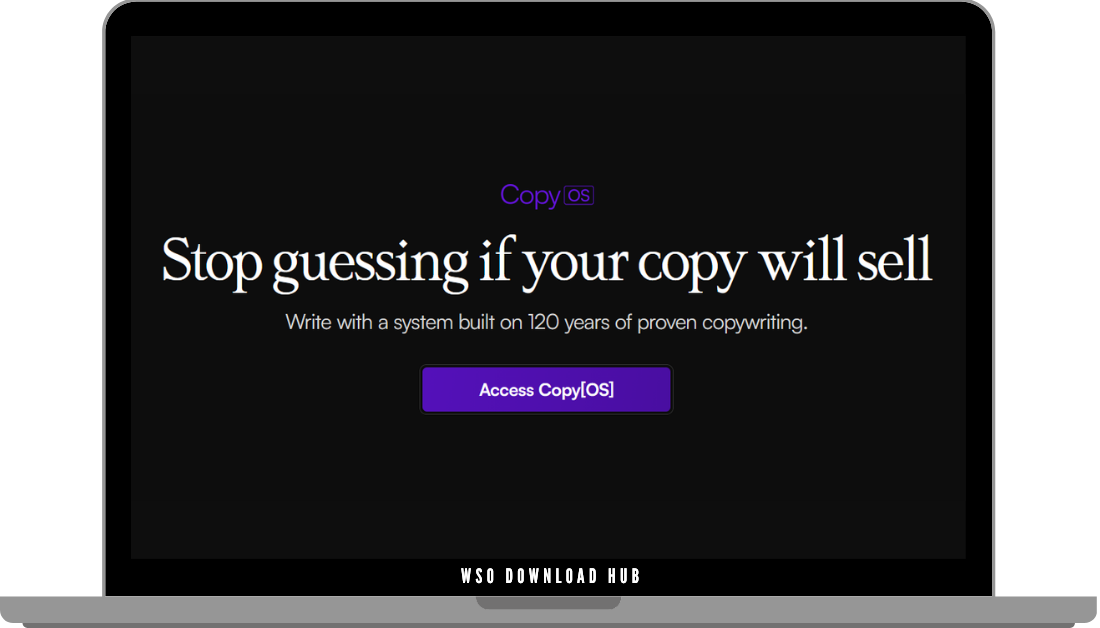
Copy OS: A Smarter System for Writing Copy That Sells
Copy OS by Felipe Botti Galende helps writers stop guessing whether their copy will convert. It brings proven copywriting knowledge into one structured system, so users can write with more clarity and confidence.
Many people use AI tools to create copy today. However, most tools produce weak results when they lack strategy, context, and judgment. As a result, the copy often sounds generic, artificial, or forgettable.
Copy OS solves that issue by organizing more than 120 years of copywriting knowledge into one practical framework. Instead of jumping between books, templates, and random tips, users get a complete copywriting operating system.
Why Copy OS Was Created
Great copywriting principles have existed for decades. Legendary marketers and writers have built frameworks that still influence sales today. However, that knowledge usually sits across many books, authors, eras, and schools of thought.
Because of that, learning copy can feel scattered. A writer may study headlines from one author, offers from another, and persuasion from another. Then, they still need to connect everything alone.
Copy OS turns that scattered knowledge into a connected system. It compares different ideas, finds repeated principles, and organizes them into a usable structure.
Therefore, users do not only collect information. They learn how the pieces work together.
What Makes Copy OS Different?
Copy OS is not just a folder of copywriting resources. It is also not a basic AI writing tool. Instead, it works as a full copywriting operating system.
The system helps users understand strategy, structure, execution, and optimization. It can guide someone through a sales page, ad, email, offer, VSL, webinar, or funnel.
In addition, Copy OS includes an AI agent trained on the same knowledge base. This helps users improve and speed up the writing process without losing copywriting fundamentals.
That matters because AI works better when it follows strong rules. With the right foundation, it can help produce sharper and more strategic copy.
What You Get Inside Copy OS
Copy OS includes a deep collection of copywriting assets, frameworks, and practical tools. Each part supports a different stage of persuasive writing.
Inside the system, users get:
- 46 authors and schools of thought.
- 112 proven copywriting frameworks.
- 32 fill-in-the-blank structures.
- 58 quality control checklists.
- 600 swipe file examples.
- 45 step-by-step copywriting processes.
- A structured vault with 14 in-depth documents.
- Access to the Copy OS AI Agent.
- Free lifetime updates.
- Lifetime access.
These resources help users write, review, and improve copy with a clearer process.
The Copy OS Vault
All core materials live inside a structured vault. This vault contains 14 detailed documents that connect with each other.
Each document solves an important part of copywriting. For example, some documents help with positioning and offers. Others help with headlines, bullets, proof, objections, funnels, and testing.
This setup helps users avoid confusion. They can move through the system based on the copy they need to create.
For instance, a user writing a sales page can start with market diagnosis. Then, they can shape the offer, build the page structure, write headlines, add proof, and handle objections.
The Four-Layer Copywriting Architecture
Copy OS uses a four-layer architecture. This structure helps users understand how persuasion works from start to finish.
Layer One: Strategic Foundation
The first layer focuses on the thinking behind strong copy. It includes the navigation system, persuasion laws, market diagnosis, positioning, and irresistible offers.
This layer helps users understand the audience before writing. It also helps them define the big idea, unique mechanism, voice, and offer structure.
Without this foundation, copy can sound clever but fail to sell. Therefore, this layer plays an important role.
Layer Two: Copy Architecture
The second layer focuses on structure. It includes universal blueprints for sales letters, VSLs, webinars, advertorials, emails, and ads.
It also covers headlines, leads, bullets, and fascinations. These pieces help users build copy that flows logically and holds attention.
Copy OS gives users headline formulas, lead types, and swipe examples. As a result, they can create stronger openings and clearer sales arguments.
Layer Three: Tactical Execution
The third layer helps users make copy more believable and persuasive. It covers proof, credibility, persuasive language, funnels, sequences, and objection handling.
This part matters because buyers often need reassurance before they act. They may have doubts, false beliefs, or unanswered questions.
Copy OS helps users address those concerns with stronger proof and clearer messaging. It also provides techniques for FAQs, testimonials, case studies, and authority building.
Layer Four: Systems and Optimization
The fourth layer focuses on improvement. It includes optimization, testing, metrics, and master swipe files.
This helps users review copy before publishing. It also supports better decisions after campaigns go live.
Instead of relying on taste alone, users can use checklists and testing frameworks. Therefore, they can improve copy with more discipline.
Why Copy OS Helps Writers Save Time
Learning copywriting from scratch can take months or years. You may need to study dozens of books and still connect the ideas yourself.
Copy OS shortens that path. It gives users a ready-made system built from major copywriting principles and frameworks.
This saves time during research, writing, and editing. It also helps users avoid weak copy caused by missing structure.
For freelancers, this can improve client work. For founders, it can improve offers and landing pages. For marketers, it can support ads, emails, funnels, and campaigns.
Using Copy OS With AI
AI can write quickly, but speed alone does not create strong copy. Good copy needs buyer awareness, positioning, proof, structure, and persuasive logic.
Copy OS includes an AI agent trained on the system’s knowledge base. This means users can use AI with better guidance.
The AI support can help users:
- Improve headlines and hooks.
- Shape stronger offers.
- Build clearer campaign briefs.
- Create better bullets and fascinations.
- Review objections and proof.
- Optimize copy before publishing.
Because the AI follows a copywriting framework, it can support better results than generic prompts.
Who Should Use Copy OS?
Copy OS suits anyone who writes persuasive content. It can help copywriters, marketers, founders, consultants, and creators.
It is especially useful for people who want a repeatable writing process. Instead of guessing what sounds good, they can follow proven structures.
Beginners can use it to understand copywriting faster. Experienced writers can use it to sharpen their process and speed up production.
The system also works well for people who use AI but want more control over quality.
Final Thoughts on Copy OS
Copy OS gives users a complete system for writing and improving persuasive copy. It combines classic copywriting knowledge, modern frameworks, swipe files, processes, checklists, and AI support.
The main value comes from structure. Users can stop collecting scattered ideas and start writing with a connected operating system.
For more marketing and business resources, visit WSO Download Hub and explore practical programs for online growth. You can also browse WSO Downloads to find more useful courses and digital training. If you want more help with ad writing, check out Mark William – 7-Figure Facebook Ad Copy Templates to support your copywriting process with ready-to-use Facebook ad templates. You can also explore Jason Caluori – Stealth Streams Elite to connect stronger copywriting with affiliate SEO, niche sites, AI-assisted content workflows, organic traffic, and better conversion-focused affiliate pages.
Sales Page
Download Link for VIP Membership Users:

About The Author